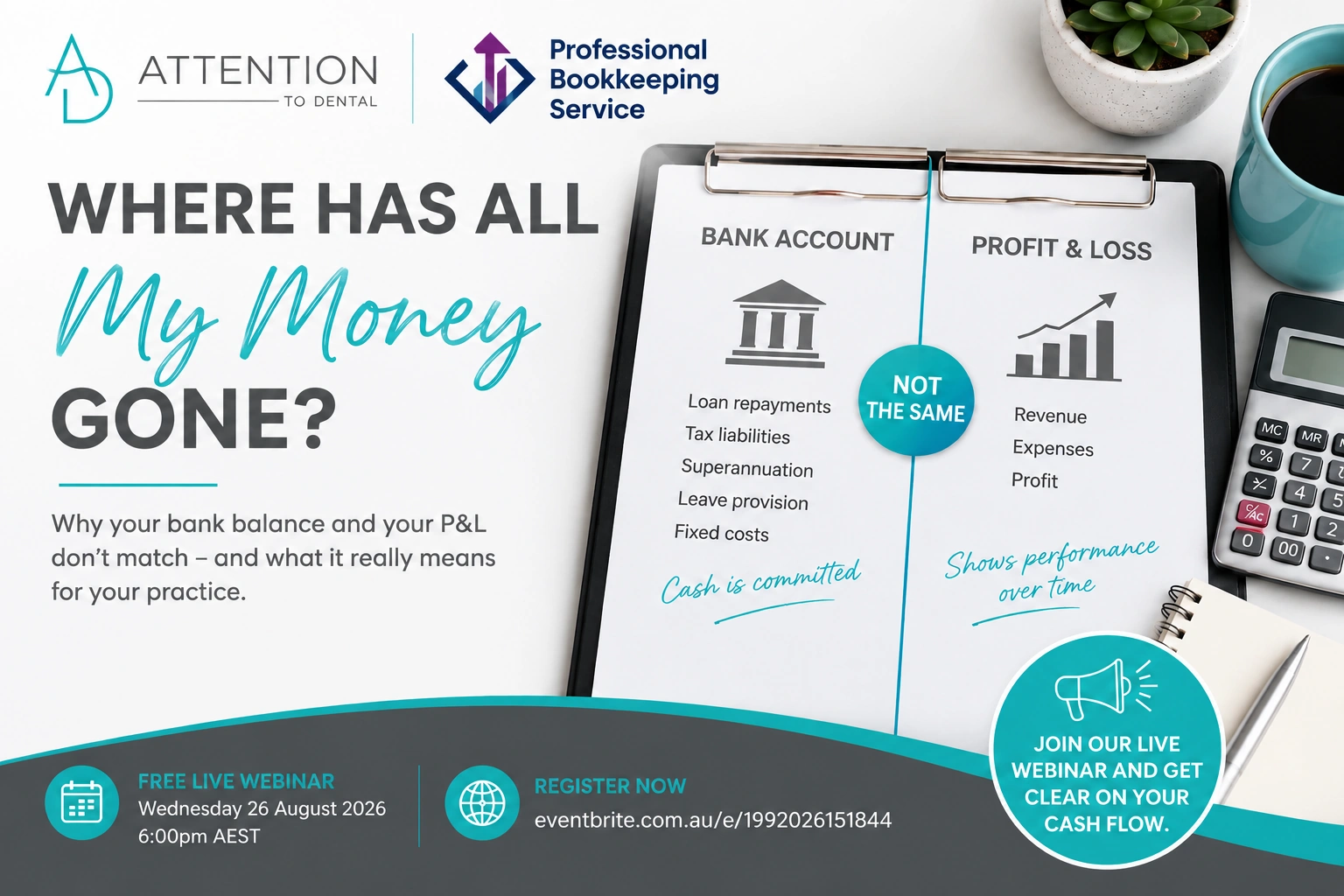

It is a situation many dental practice owners know well: the profit and loss statement looks healthy, revenue is holding up, expenses appear reasonable and, on paper, the practice is making a profit, yet the bank account seems to be telling a completely different story.
This is where the familiar question begins to surface: where has all the money gone?
In many cases, the problem is not that the practice is performing poorly, but that the profit and loss statement and the bank account are measuring different parts of the financial picture. Understanding that distinction is one of the most useful financial concepts a practice owner can learn, because a business can be profitable on paper while still experiencing genuine cash flow pressure.
Profit does not automatically mean cash
Your profit and loss statement is designed to show how the business has performed over a period of time by recording the revenue earned and the expenses associated with running the practice. What it does not show clearly is every movement of cash in and out of your bank account, which is often where the confusion begins.
Take a business loan as an example. Your monthly repayment may be several thousand dollars, but only the interest component is generally recorded as an expense on the P&L, while the principal portion reduces the loan balance on your balance sheet. The cash has still left your bank account, but it has not reduced your reported profit in the same way, which means a practice can appear to be performing well while a significant amount of cash is being used to reduce debt.
Tax creates a similar disconnect. A practice can generate profit throughout the year and build up a future tax liability, while the cash remains sitting in the bank until the payment is actually due. This can create a false sense of comfort because the money appears to be available, even though part of it may already be committed to the ATO.
The balance sheet matters more than many owners realise
Most practice owners naturally spend more time looking at their P&L because it is familiar, relatively easy to understand and usually forms the basis of conversations around revenue, wages and profitability. The balance sheet, however, is often given far less attention, even though it contains some of the most important information about the financial obligations that will affect future cash flow.
Business loans, tax liabilities, superannuation payable and other amounts the practice owes are all recorded there, so reviewing only the P&L means looking at one part of the financial story rather than the whole picture.
This is one of the reasons a practice can look profitable while still feeling constantly short of cash, because the P&L may be showing strong performance at the same time that the balance sheet is carrying significant obligations that will ultimately need to be paid.
The timing of cash is often the real issue
Cash flow problems are not always caused by insufficient revenue. In many cases, they are caused by the timing of when money comes in compared with when it needs to go out.
A practice might have a strong month of collections and feel financially comfortable, only to have several large obligations fall due soon afterwards, including BAS, superannuation, payroll tax, income tax, annual insurance, equipment finance, staff leave or the ongoing fixed costs that continue through a Christmas closure.
None of these expenses should necessarily be unexpected, but without a clear system for allowing for them in advance, they can create the impression that money has suddenly disappeared when, in reality, the issue is that the cash was never truly available to spend in the first place.
Stop treating the entire bank balance as available cash
One of the simplest improvements a practice can make is to stop viewing the total bank balance as money that is immediately available to spend, because a portion of that balance will often already be committed to future obligations.
A practical cash management system separates money according to its purpose so that funds set aside for tax, superannuation, payroll-related liabilities, annual leave, equipment commitments or quieter trading periods are clearly distinguished from cash that is genuinely available for day-to-day spending or investment.
The exact structure will differ from one practice to another, but the principle remains the same: when committed cash is visible and deliberately separated, practice owners are far less likely to make decisions based on a bank balance that overstates what is actually available.
A healthy bank balance can sometimes be misleading
This becomes particularly important after a strong period of revenue, when a larger-than-usual operating account balance can make the practice feel more financially secure than it really is.
That sense of security can lead to decisions such as purchasing equipment, increasing owner drawings, adding staff or committing to new expenses, all of which may be completely appropriate provided they are based on the amount of cash that is genuinely available after upcoming obligations have been considered.
Before making a significant financial decision, a practice owner should be able to answer a simple question: what portion of this balance is actually available once our known commitments are taken into account?
If that question is difficult to answer, the issue is not necessarily a lack of profitability, but a lack of visibility around cash flow.
What good cash flow management actually looks like
Good cash management is not about keeping unnecessarily large amounts of money sitting idle, nor is it about checking the bank account more often. It is about understanding what your cash needs to do before you decide how it can be used.
A practice with clear financial visibility is in a much stronger position to make decisions about whether it can afford another employee, when to invest in equipment, how much the owners can safely draw, how a quieter month may affect the business and whether costs are beginning to increase faster than revenue.
That confidence comes from understanding how the P&L, balance sheet and bank account work together, because each one tells a different part of the financial story. The P&L shows whether the practice is profitable, the balance sheet shows what the practice owns and owes, and the bank account shows how much cash is physically available at a particular point in time.
When all three are reviewed together, the financial position of the practice becomes much clearer and the question of where the money has gone becomes far easier to answer.
Still Asking, “Where Has All My Money Gone?”
This is exactly what we will be unpacking in our upcoming Where Has All My Money Gone? webinar, where we will take the financial reports many practice owners already receive and turn them into practical information that can be used to understand where the money is going, what the numbers are really saying and where financial pressure may be developing before it becomes a larger problem.
Where Has All My Money Gone?
Wednesday 26 August 2026 at 6:00pm AEST
Live online webinar
Register here:
https://www.eventbrite.com.au/e/1992026151844?aff=oddtdtcreator
If you have ever looked at a profitable P&L and then wondered why the bank account does not seem to agree, this session will help connect those dots and give you a much clearer understanding of what is really happening behind the numbers.
To discover more about the numbers in your practice, Book a free, no-obligation call with Chris Stenhouse, Managing Director of Professional Bookkeeping Service.
This article is general information to help you understand your numbers — it isn't personalised financial advice. Every practice's situation is different, so if you'd like help applying this to your own books, Professional Bookkeeping Service is here to walk through it with you.
Share The Article: