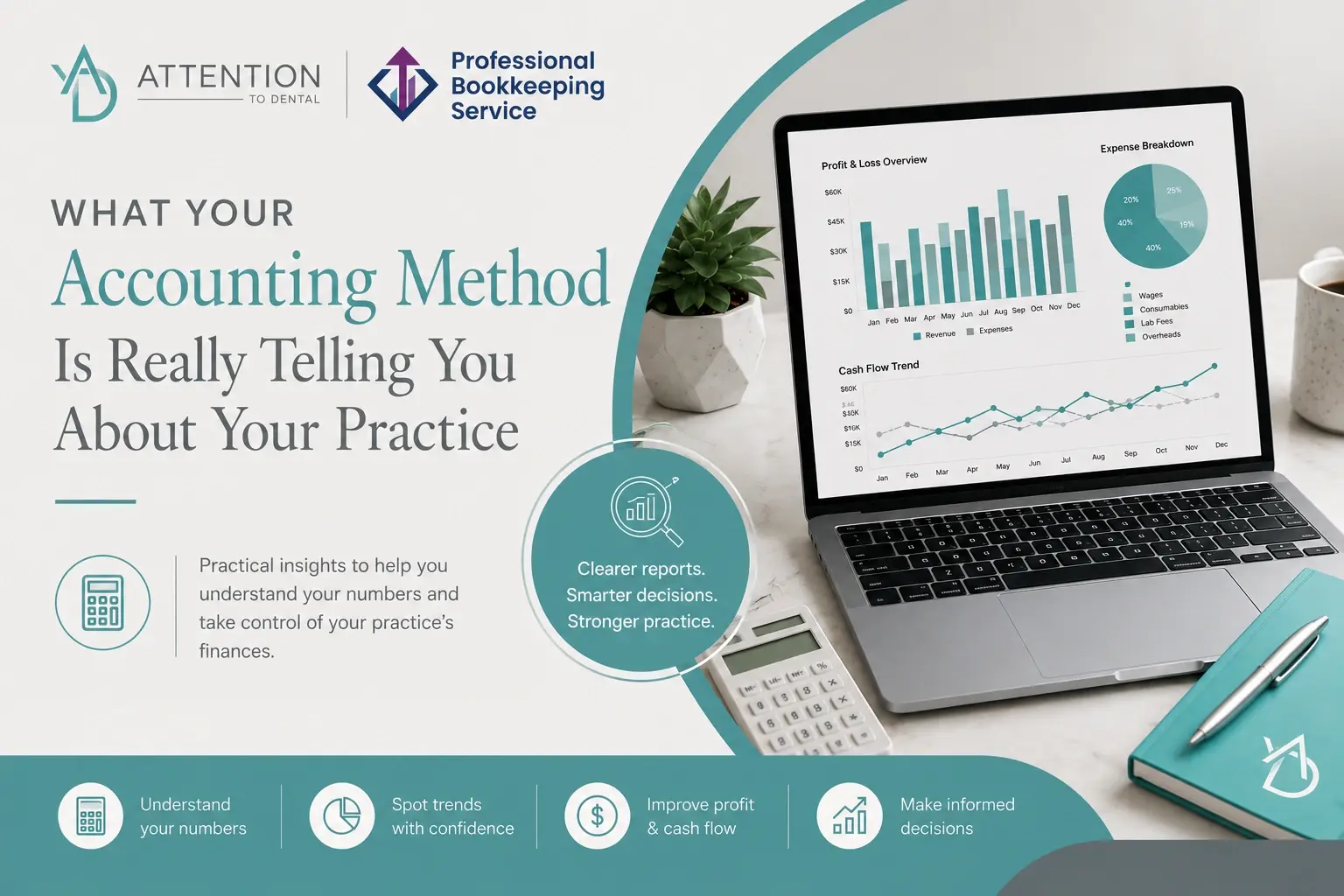

When I meet with practice owners to review their financial reports, one comment comes up more often than almost any other. They'll look at a Profit and Loss Statement or Balance Sheet, shake their head, and say, "I look at these every month, but I'm not really sure what they're trying to tell me." It's an understandable frustration because financial reports are supposed to provide clarity, yet for many business owners they often seem to create more questions than answers.
The natural assumption is that understanding the reports requires more accounting knowledge, but in many cases that isn't the problem at all. Quite often the difficulty lies in the way the reports are being prepared, and more specifically, the accounting method that sits behind them. The numbers themselves may be accurate, yet the way they are presented can make it surprisingly difficult to identify what is actually happening within the business.
One of the first things we review when we begin working with a dental practice is whether the accounting file is maintained on a cash or accrual basis. It's a decision that is often made when the practice is first established and then rarely revisited, even though the business may have changed dramatically over the years. What suited a start-up practice with a handful of transactions each week may no longer provide the level of insight required for a busy, growing business employing multiple team members and managing significant operating expenses.
Understanding the difference
The distinction between cash and accrual accounting is actually quite straightforward, despite the technical language that often surrounds it.
Under cash accounting, income is recognised when payment is received and expenses are recognised when they are paid. In other words, the financial reports reflect the movement of money through your bank account rather than the timing of the business activity itself.
Accrual accounting, on the other hand, records income when it is earned and expenses when they are i ncurred, regardless of when the cash changes hands. This means that revenue is recognised when an invoice is issued and expenses are allocated to the period they actually relate to, providing a far more accurate reflection of how the business has performed during that month.
At first glance the difference may appear insignificant, but it has a profound impact on the quality of the information you're using to make business decisions.
Take something as simple as your annual professional indemnity insurance. If the premium is paid in July under a cash accounting system, the entire expense appears in your July Profit and Loss Statement, making that month look considerably more expensive than the eleven months that follow. Nothing about the business has fundamentally changed—you've simply paid a yearly expense in one transaction. Under an accrual accounting system, however, that same expense is spread across the twelve months it relates to, creating a much more balanced and meaningful representation of your operating costs.
The same principle applies to software subscriptions, equipment maintenance contracts, annual licences, prepaid rent and a wide range of other expenses that don't naturally belong in a single reporting period.
The problem with financial "noise"
One of the simplest ways to understand the difference between cash and accrual accounting is to think about the amount of "noise" that exists within your financial reports.
Cash accounting has a tendency to introduce timing differences that can distort what you're seeing. A supplier invoice paid a week later than usual, a payroll processed earlier because of a public holiday, or two rent payments falling within the same reporting month can all create the impression that something unusual has occurred when, in reality, the underlying business has remained relatively consistent.
Over time these timing differences accumulate, making it increasingly difficult to identify genuine trends. A practice owner reviewing the reports may begin questioning whether wages have increased, whether consumable costs are getting out of control, or whether profitability is declining, when much of the apparent variation is simply the result of when payments happened to clear the bank.
This is one of the reasons so many businessowners gradually lose confidence in their financial reports. When the figures appear inconsistent from one month to the next, it becomes difficult to determine whether you're looking at a genuine business issue or simply an accounting timing issue.
The "Where's Wally?" analogy
One of my favourite ways to explain this concept is by thinking about a Where's Wally? puzzle.
Finding Wally isn't difficult because he's hidden. He's difficult to find because every page is filled with hundreds of colours, patterns and characters competing for your attention, making it almost impossible to immediately distinguish what matters from everything else.
Now imagine exactly the same illustration, except every other character was coloured blue.
Suddenly Wally would stand out almost instantly.
That's exactly what good financial reporting should do.
The purpose of management reporting isn't to provide more information—it's to remove unnecessary distractions so the information that genuinely matters becomes obvious.
Cash accounting often fills reports with visual clutter created by timing differences. Accrual accounting removes much of that clutter by matching income and expenses to the period they belong to, allowing genuine changes in business performance to become far easier to identify. Instead of wondering why one particular month suddenly looks unusually expensive, you're able to focus on the questions that really matter. Have wages increased? Why have laboratory costs risen? Is the practice becoming more profitable? Are our overheads beginning to creep higher than expected?
Those are the questions that lead to better business decisions.

Why clearer reports matter
One thing I've observed over many years of working with dental practices is that owners rarely ignore their financial reports because they aren't interested in the numbers. More often than not, they stop relying on them because the reports don't appear to tell a consistent story, and when confidence in the information disappears, it's only natural to start focusing on the figures that seem easiest to understand.
For many practice owners, that means watching revenue while paying far less attention to profitability, operating costs and financial trends.
Unfortunately, revenue on its own tells only part of the story. Two practices can generate almost identical monthly production while producing vastly different levels of profit, simply because one practice has tighter control over wages, consumables and operating expenses.
Without reliable reporting, those differences often remain hidden until they begin affecting cash flow or profitability in a meaningful way.
Accrual accounting provides a much stronger foundation for management reporting because it allows practice owners to compare one month against another with greater confidence, knowing that the figures reflect the period in which the business activity actually occurred rather than the timing of individual payments.
Why this is particularly important in dentistry
Dental practices operate in an environment where expenses rarely occur in perfectly predictable patterns. Wages fluctuate as staffing levels change, laboratory fees vary depending on treatment mix, equipment purchases are often irregular, and consumable costs can increase significantly during particularly busy periods. Overlay annual subscriptions, insurance premiums and software renewals, and it's easy to see how cash accounting can create reports that appear inconsistent despite the practice operating quite normally.
When those timing differences are removed through accrual accounting, the reports begin to tell a much clearer story. Budgeting becomes more reliable, forecasting becomes more meaningful, and identifying unusual movements becomes considerably easier because you're comparing like with like.
Rather than wondering whether an unusually expensive month represents a genuine issue, you can quickly determine whether the increase reflects a change in operating performance or simply the timing of a payment that relates to the rest of the year.
A common misconception
One concern we occasionally hear is that moving to accrual accounting means losing the ability to produce cash-based reports for taxation or compliance purposes. Fortunately, that isn't the case.
A practice maintained on an accrual basis can still generate cash-based reports whenever they are required, giving you the flexibility to satisfy compliance obligations while also benefiting from management reports that provide a far more accurate understanding of your business.
The reverse, however, isn't true. A file maintained purely on a cash basis doesn't provide the same depth of reporting or flexibility, which means practice owners often miss valuable opportunities to better understand the financial performance of their business.
The bottom line
Financial reports should help you make decisions with confidence, not leave you second-guessing every number on the page. If your reports seem inconsistent from one month to the next, or you often find yourself wondering why the figures don't quite make sense, the issue may not be your understanding of finance at all. It may simply be that the accounting method behind the reports is no longer giving you the information your practice needs.
Sometimes the biggest improvements in business decision-making don't come from learning to read more reports; they come from ensuring the reports you're reading accurately reflect what is happening within your practice. Once the unnecessary noise has been removed and the numbers begin telling a clearer story, you'll often find that managing the financial side of your business becomes significantly less overwhelming and far more valuable as a tool for future growth.
If you would like to discover more about your financial reports Book a free, no-obligation call with Chris Stenhouse, Managing Director of Professional Bookkeeping Service.
This article is general information to help you understand your numbers — it isn't personalised financial advice. Every practice's situation is different, so if you'd like help applying this to your own books, Professional Bookkeeping Service is here to walk through it with you.
Share The Article: